An Unconventional Bouquet in Le boucher
I had the absolute pleasure of seeing Le boucher on the big screen this week courtesy of the Filmhouse in Edinburgh, and what a treat it was to revisit this taut, quietly unsettling thriller from Claude Chabrol. There’s so much to discuss within the film (I’ve been threatening to write properly about Chabrol for over a decade now) but for the moment, one small visual detail keeps lingering in my mind.
When the film’s titular butcher, Popaul, visits the provincial school Hélène presides over as headmistress, he eschews the familiar romantic gesture of flowers and instead presents her with a leg of lamb wrapped in white butcher’s paper, arranged to resemble a bouquet. It’s a wonderfully dry visual joke, the butcher substituting flowers with meat, yet it also captures Chabrol’s talent for folding humour, menace and character insight into a single image, something that surfaces even within the director’s darker psychological work.
The scene occurs at the beginning of their courtship and in these initial stages, Popaul’s offering feels thoughtful in his own awkward way, yet it also serves as a reminder of his profession, his wartime past and his intimate familiarity with violence, as well as the film’s broader interest ih the uneasy proximity of love and brutality. In a single disarmingly humorous image, Chabrol filters courtship through flesh and romance through mortality. In retrospect, the gesture takes on a far darker resonance, and its tenderness becomes inseparable from the violence it quietly foreshadows.
Le boucher screened at the Filmhouse as part of their Nouvelle Vague season which included films by Truffaut, Godard, Rohmer and other key figures of the movement, to coincide with the release of Richard Linklater’s Nouvelle Vague, which features Antoine Besson portraying Chabrol. If you ever get the opportunity to see Chabrol on the big screen, particularly Le boucher, which is not always the easiest film to encounter theatrically, I would strongly encourage you to take it. Chabrol’s control of tone and atmosphere works beautifully via the magic of the big screen.
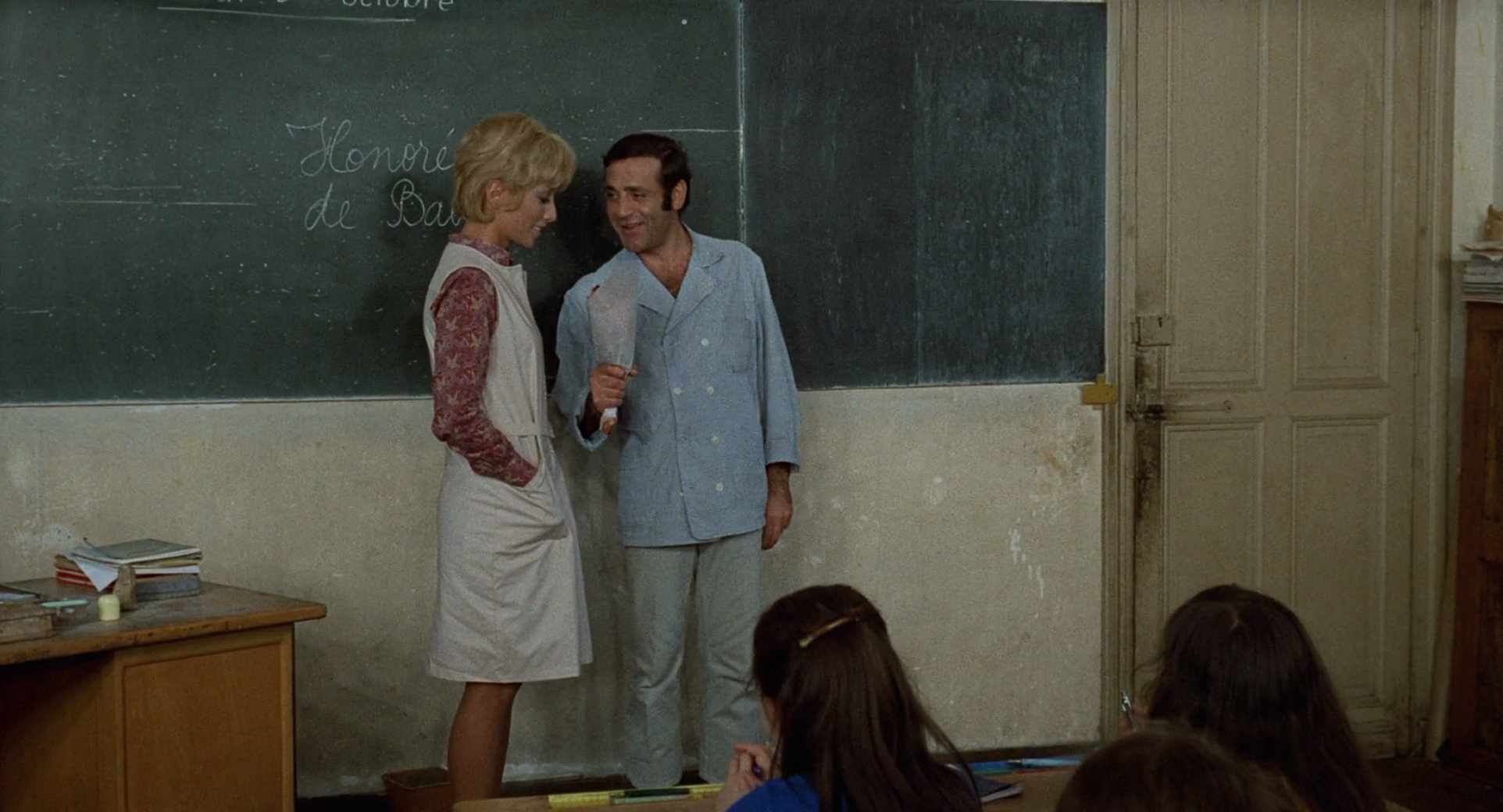
Le boucher (Claude Chabrol, 1970)
