Telefono in Chiave Minore
If you used to read the old Hypnotic Crescendos blog, you might remember a post I wrote many moons ago about telephones in giallo cinema. I may revisit and migrate it over to this site at some point, but in the meantime, here’s a short and sweet appreciation of another telephone I love from the world of Italian thrillers. This one isn’t technically from a feature film, but from television: Sergio Martino’s Delitti privati (1993), also known as Private Crimes, a Twin Peaks-inspired mystery starring giallo scream queen and bonafide icon Edwige Fenech.
I genuinely couldn’t believe it when Severin announced their release of Private Crimes, At last, I could say goodbye to that battered bootleg Channel 4 recording! Beyond simply making the series easier to revisit, the Severin release also meant being able to appreciate and share small visual details in far better quality, like this wonderfully distinctive piano themed telephone seen in the residence of Nicole Venturi (Fenech) and her daughter, Sandra (Vittoria Belvedere).
The phone in question is a Betacom Grand Piano Telephone. Produced in the late 1980s, this model is a perfect example of when novelty telephones were briefly fashionable as decorative status objects rather than purely functional household devices. Here, it feels particularly fitting, as Sandra Durani is a music student at a conservatory, poised on the brink of a singing career, studying alongside her pianist boyfriend Paolo (Lorenzo Flaherty). The phone sits beside a photograph of Sandra and Paolo taken during the operatic performance that opens the first episode. A sheet of music rests alongside it, forming a perfect triptych of musical memory.
That piano telephone instantly transported me back to Edinburgh in the 1990s, when there was a phone shop at the West End selling novelty models shaped like Disney characters: Pluto, Betty Boop, the works… As a child, I always thought these were the coolest markers of adulthood, a small domestic object that loudly announced who you were. It’s strangely satisfying to see that same sensibility appear here, where the telephone doesn’t feel so much as a practical device but more like a stylish extension of character and environment.
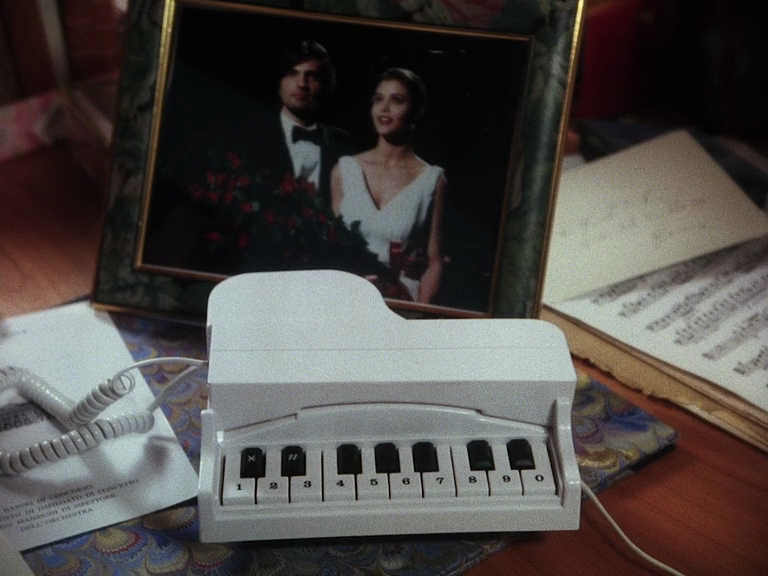
Delitti Privati (Sergio Martino, 1993)
