Argento’s Inferno Slithers into Anaconda
Modern horror filmmakers are in a distinctly self-reflexive mood. The postmodern habits of quotation, recycling and genre awareness are hardly new; they have been circulating in horror for decades. But by the mid-1980s, horror was increasingly turning inward with films such as Demons (Lamberto Bava, 1985) and Anguish (Bigas Luna, 1987) destabilising the boundary between spectator and spectacle, while franchise entries such as A Nightmare on Elm Street 3: Dream Warriors (Chuck Russell, 1987) began openly playing with their own conventions. These films didn’t redefine the market, but they signalled a genre beginning to look back at itself. It was famously Scream (Wes Craven, 1996) that crystallised the shift for the multiplex era. A slasher that anatomised slashers, making genre literacy part of the plot machinery.
Modern horror has subsequently inherited that self referential grammar. If earlier horror films toyed with self-awareness, contemporary horror seems especially comfortable turning the camera back on itself.
Italian horror, and the giallo in particular, has long been part of that intertextual exchange. Well before horror became openly self-reflexive, American slashers were already drawing on the giallo’s visual and structural grammar utilising familiar components of the filone such as subjective point-of-view camerawork, stalking structures and an emphasis on murder as choreographed spectacle. That influence was embedded in the genre long before it was ever explicitly acknowledged. In more recent years, however, that borrowing has become explicit: variously spoofed, honoured, retooled and reabsorbed in North American cinema, from the affectionate pastiche of The Editor (Adam Brooks and Matthew Kennedy, 2014) to the studio-funded exploitation delirium of Malignant (James Wan, 2021) and the glossily decadent 80’s stylisation of A24’s MaXXXine (Ti West, 2024). Argento’s cinema, in particular, has become a visible touchstone, whether through overt homage or through subtler echoes of his operatic approach to horror.
However, what feels perhaps more recent, is the way Italian horror fandom itself has become visible on screen. Once a niche, late-night-VHS subculture, it now operates as character shorthand: a signifier of obsessive cinephilia, cultivated taste, or slightly performative devotion to “real” horror. Scream VI (Tyler Gillet and Matt Bettinelli-Olpin, 2023), nods to this directly, from a character’s wounded pride over a disappointing mark on his giallo film studies essay to the Four Flies on Grey Velvet (Dario Argento, 1971) baseball tee he wears as a mark of his niche taste.
Which brings us to Anaconda (Tom Gormican, 2025), a meta-reboot that revisits creature-feature territory whilst situating itself within a landscape acutely aware of horror history.
The film stars Jack Black as Doug McCallister, a once-aspiring filmmaker who has now been reduced to a career shooting generic wedding videos. He is a man who directs other people’s climaxes while his own life and career have quietly fossilised. His childhood friend, Ronald “Griff” Griffin Jr., works as a Hollywood extra struggling to land that elusive breakout role that might finally launch his career, while their friends Kenny Trent and Claire Simons have taken more mundane paths away from their childhood filmmaking dreams.
Doug’s office quietly preserves those unrealised dreams. On the wall hangs a poster for Dario Argento’s Inferno (1980), long associated with the most nightmarish imagery of Italian horror: a hollowed pink and blue skull suspended against darkness, presiding over a desk dedicated to wedding edits and client invoices. Baroque terror, once the object of admiration and ambition, now functions as background décor in a life governed by administrative routine.
While I’m not suggesting that the inclusion of Inferno’s poster carries any grand intertextual intent beyond an appreciative nod, it is nonetheless an apt choice. Argento’s film is steeped in serpentine and lacertine imagery, from jewelled Bulgari brooches to architectural reliefs and tiled interiors, making Inferno’s presence in a film about a colossal anaconda feel somewhat fitting.
It’s also feels fitting that the poster isn’t the more obvious cinematic choice of Suspiria (1977). Inferno was itself a follow-up to a landmark film, living slightly in its shadow - an echo that sits comfortably inside a project like Anaconda, which directly references its original while folding that awareness into the narrative.
If the reflexivity of Anaconda operates at the level of genre history, its appeal works on more than one register. Some viewers will recognise it as a return to a formative title, tied to early multiplex creature features. Others will meet it for the first time, encountering the original’s afterlife alongside a creature-feature tradition that stretches back decades.
The film’s self-awareness doesn’t require prior knowledge of its source material, but it naturally rewards it. Viewers familiar with genre cinema will recognise the myriad of references here: the Inferno poster, the strategic placement of Close Encounters of the Third Kind, All That Jazz, and the original Anaconda posters within the studio scenes, as well as the film’s nods to creature-feature mechanics and the original film itself. It’s a fun, knowing glance at the genre’s own past, a reminder that horror can be both self-aware and unabashedly pulpy and that sometimes the pleasure lies in recognising where it all began.
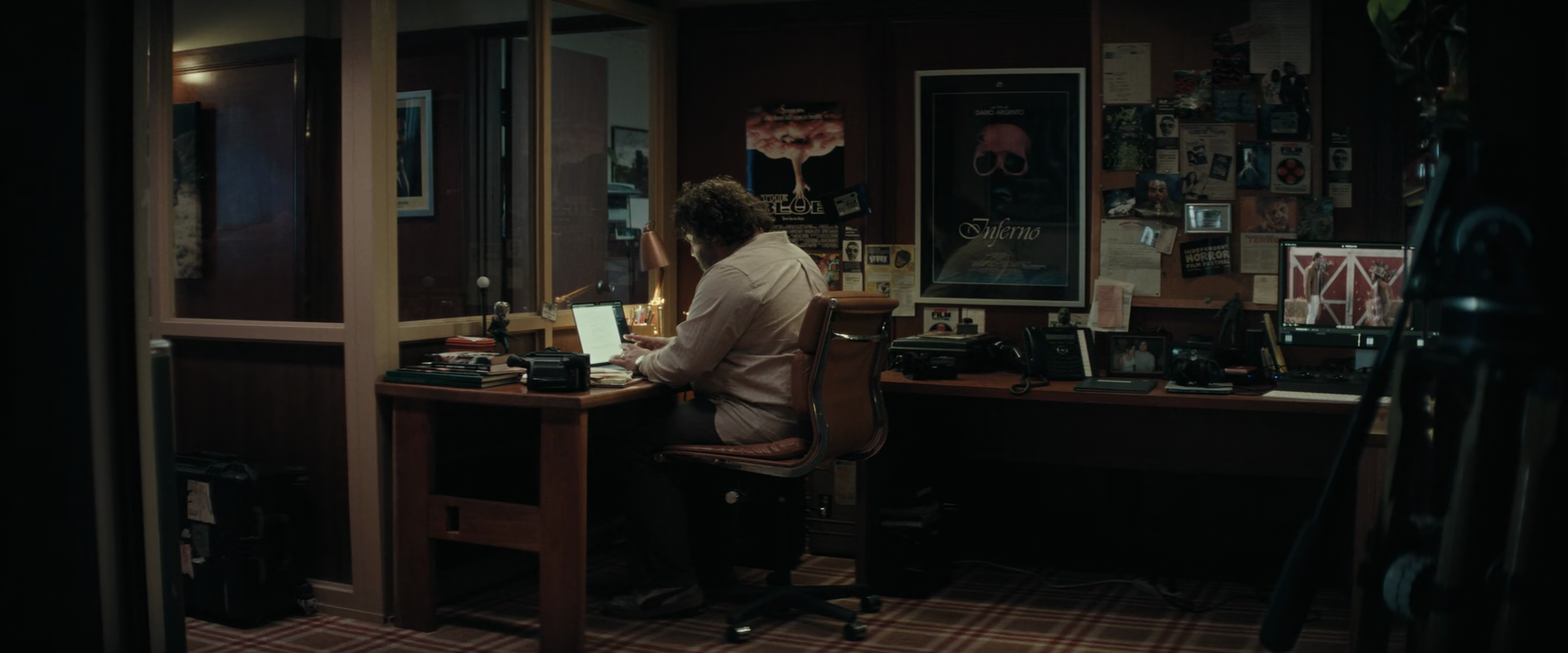
Jack Black beneath an Inferno (1980) poster in Anaconda (2025).
