Verner Panton in Film: The Spiegel Interiors in Ohrfeigen (1970)
Few designers are so closely associated with the mood of a decade as Verner Panton is with the late 1960s. In the current age of digital image culture, his radical interiors circulate endlessly online, colour-drenched rooms of moulded plastic and synthetic textile organised into modular geometries that seem almost designed for algorithmic repetition. They are routinely described as cinematic, set-like, even futuristic, and over time he has become a kind of visual shorthand for the colourful plastic optimism of the period.
Among Panton’s most significant realised works was his 1969 commission for the Der Spiegel publishing house in Hamburg, a rare instance in which he was able to shape an interior environment at almost every level. His approach extended across the building’s principal spaces, from the entrance courtyard and lobby to editorial conference rooms, lounges and bar areas. Even the employee swimming pool in the basement was treated as part of the same interior logic, its coloured surfaces and integrated lighting aligning it more closely with the building’s social spaces than with a conventional workplace amenity. A tightly controlled use of colour unified these disparate spaces, running through custom lamps, textiles and wall claddings and reinforced by a mirror lighting system integrated across walls and ceilings, which reflected and redistributed light across the interior. As with many ambitious modern interiors, however, the scheme did not remain intact. The swimming pool was lost to fire and the entrance remodelled in the 1990s. Only the dining room survives in anything approaching its original form, now reconstructed inside the Museum für Kunst und Gewerbe as a rare instance of large-scale interior preservation from the late 1960s.
And yet, for all the talk of the cinematic qualities of Panton’s work, there is remarkably little documentation of his interiors appearing in cinema. His furniture appears, most famously the Pantonova seating in The Spy Who Loved Me (1977), but his immersive architectural environments seem largely absent from film history.
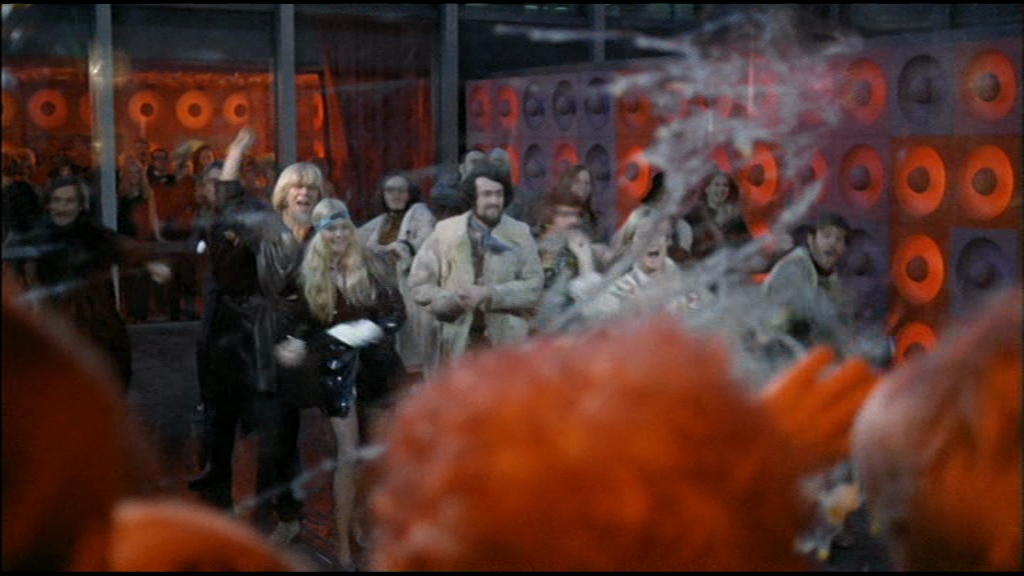
So it was something of a surprise when I stumbled across Panton’s Spiegel interiors on film, a rather fortunate by-product of researching Rolf Thiele’s late-sixties work. To my knowledge, the connection hasn’t been acknowledged before so as always, it’s nice to be able to bring new observations to the fore! The film in question is Thiele’s Ohrfeigen (1970), a German comedy shot in and around the Spiegel building in Hamburg, in which multiple Panton-designed spaces appear on screen. It follows Eva, a young revolutionary living in a self-styled leftist commune funded by inherited company shares. When a calculating financier manipulates the company’s value for his own gain, Eva and her comrades respond with theatrical acts of resistance, turning corporate space into a stage for ideological confrontation.
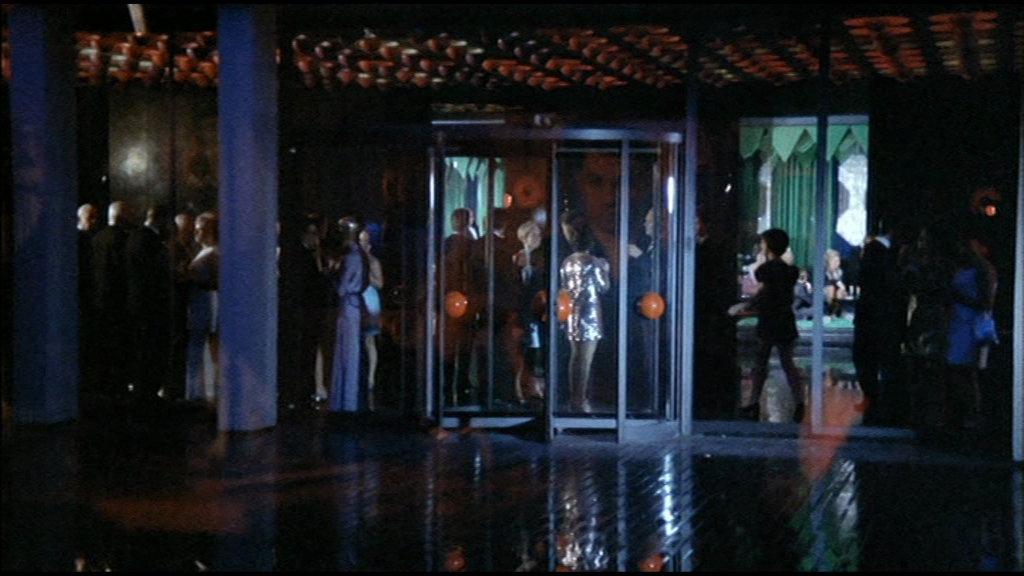
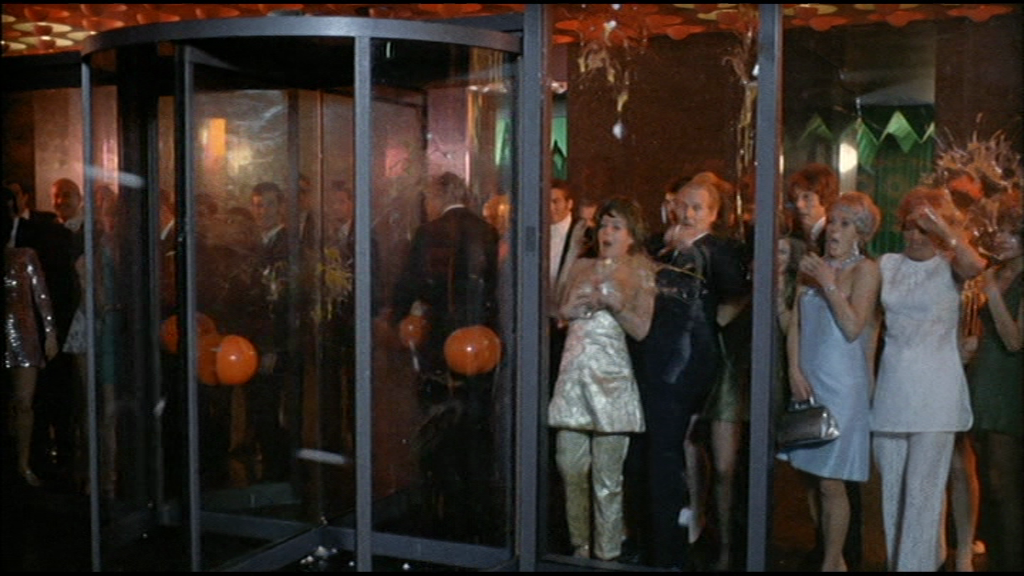
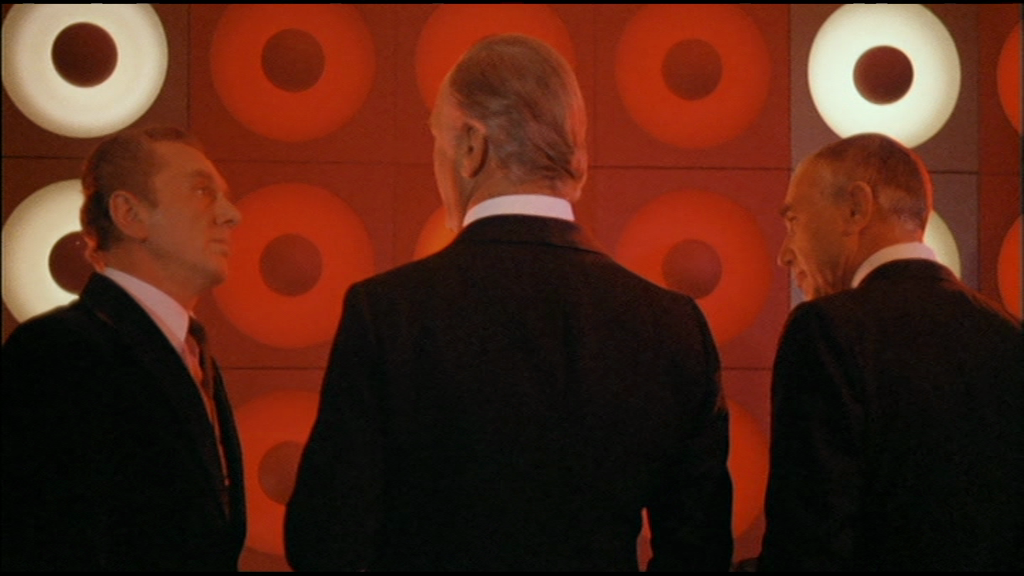
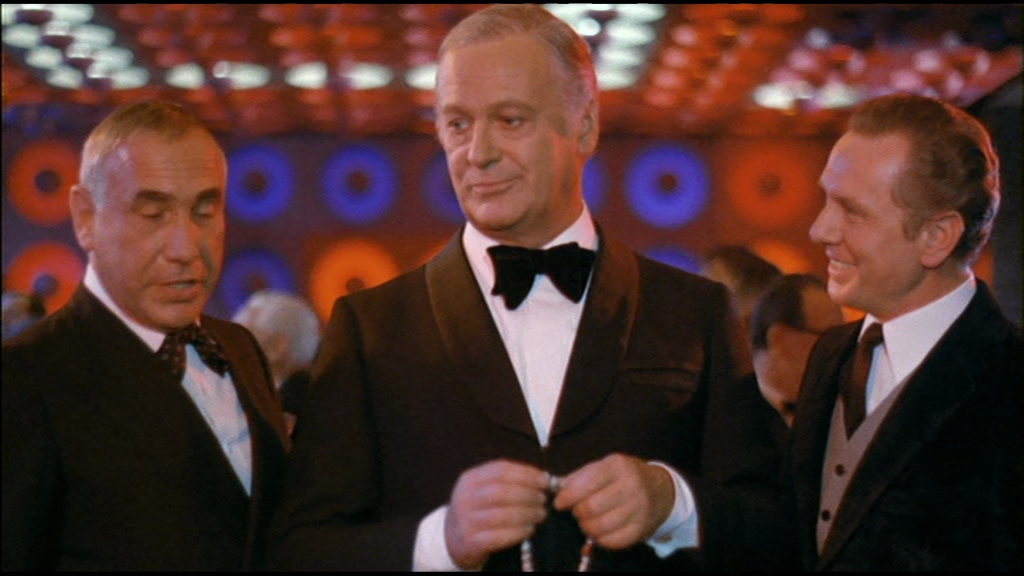
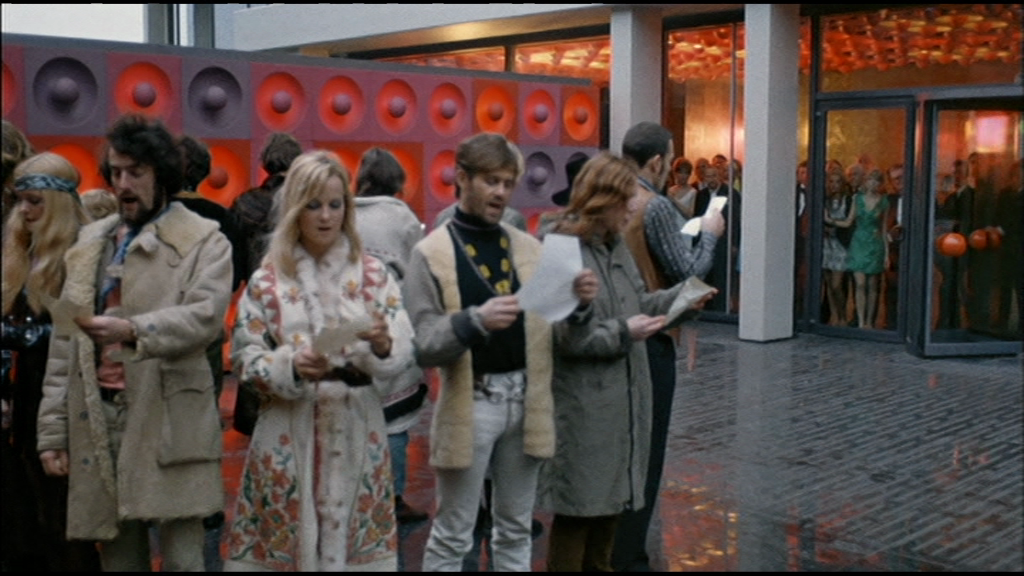
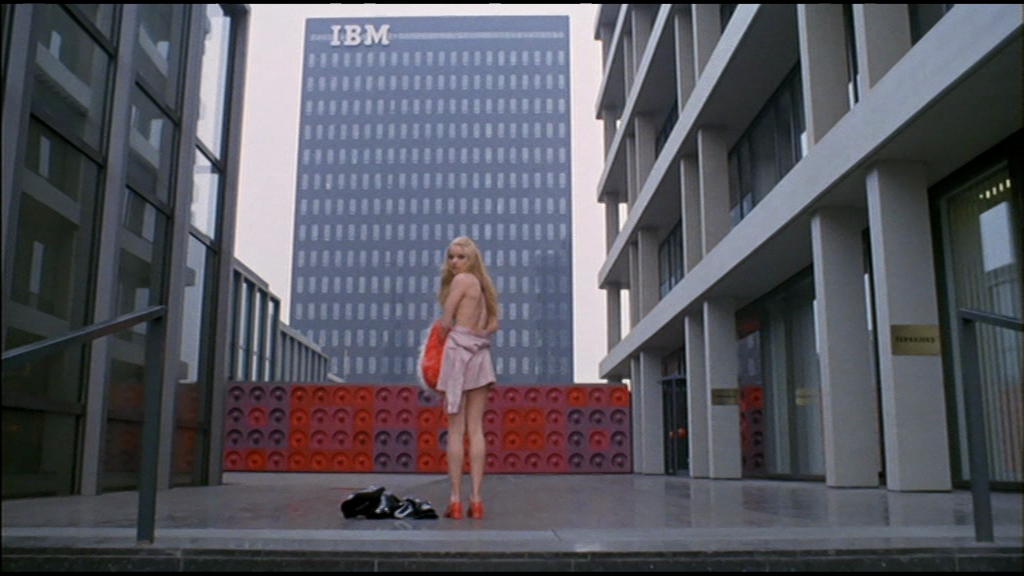
Many of these scenes play out within the Spiegel building’s carefully orchestrated interiors. The scenes shot in the building’s entranceway, staged here for both a sophisticated party and a revolutionary protest, establish Panton’s system from the outset. In the courtyard, a wall of circular modules in alternating red and blue tones lines the exterior, announcing the building’s visual language before one even steps inside. The revolving door, fitted with orange globe handles, then delivers visitors directly into a lobby where the same discs continue across walls and ceiling, their recessed centres set within darker surrounds. The threshold is a deliberate designed transition, marking movement into a fully saturated environment in which surface, structure and illumination operate as a single scheme.
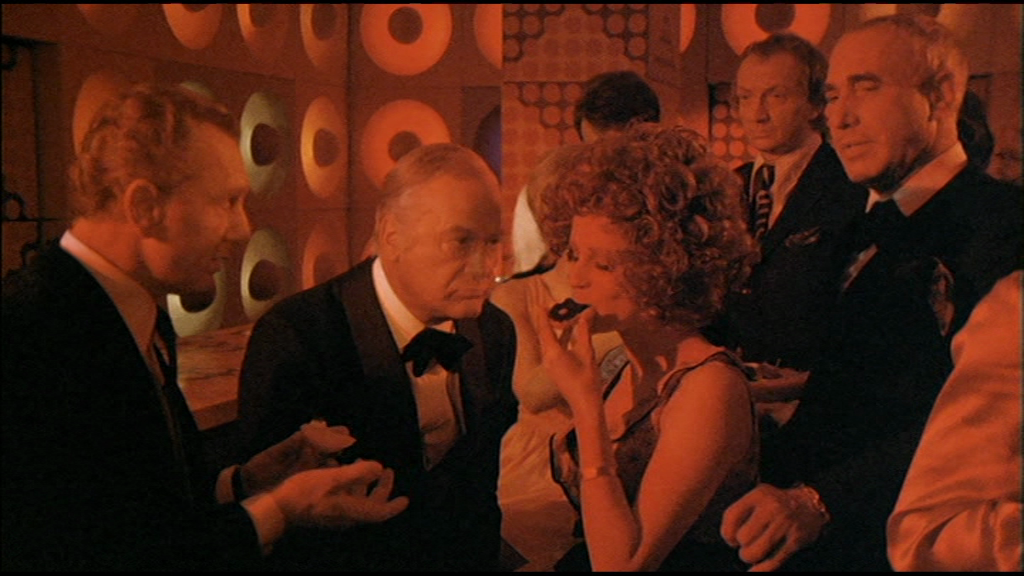
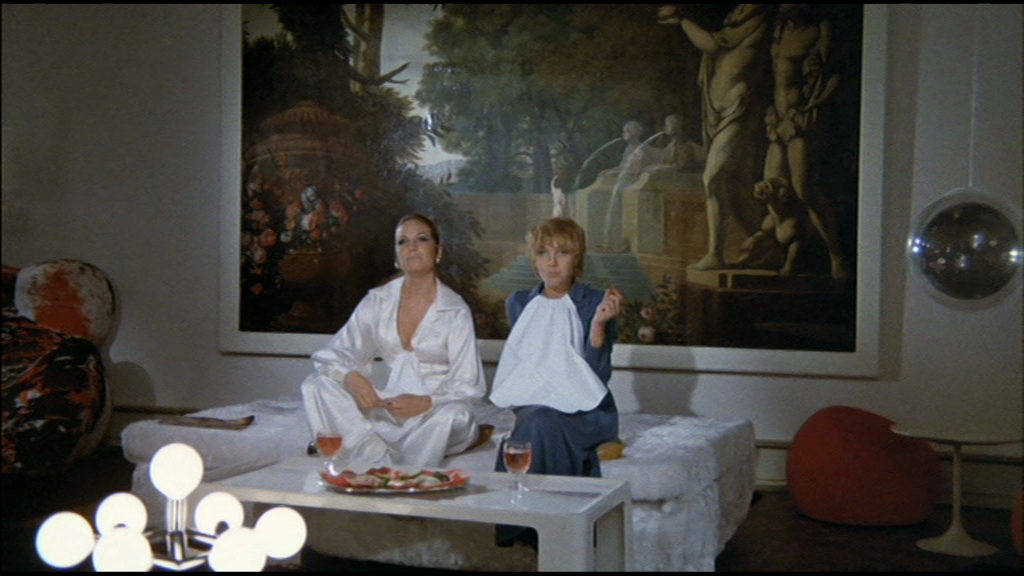
From there, the film moves deeper into the building. Several scenes unfold across the interiors of the Spiegel building, capturing their colour zoning, built-in structures and Panton’s integration of lighting into the architecture. Fields of orange and red appear behind the actors, circular wall modules repeating across the frame as pattern and light source. In the canteen scene, these modular glowing walls sit behind characters eating crudités and drinking champagne, the architecture functioning as a focal point and a persistent chromatic presence.
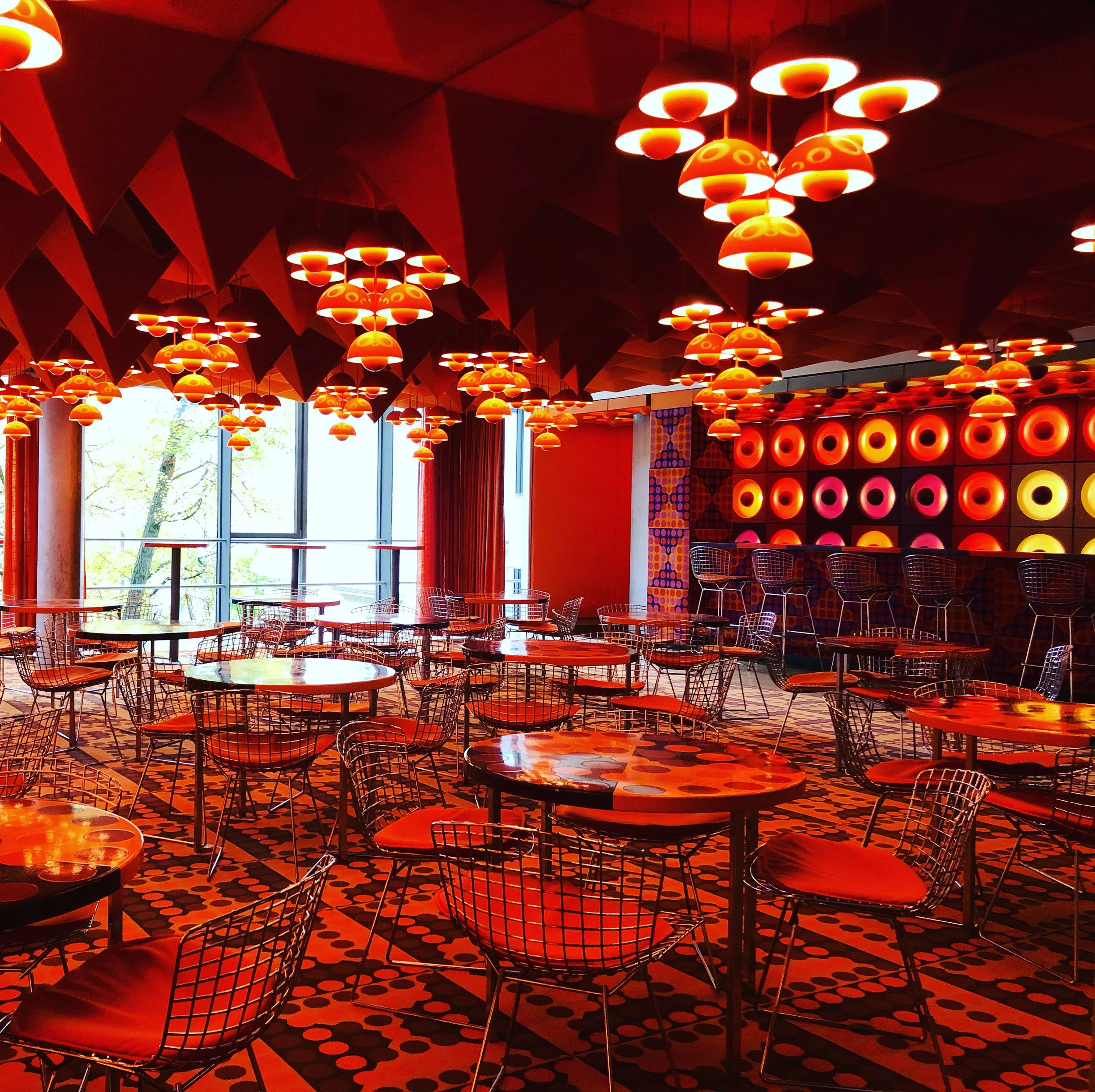
The reconstructed Spiegel canteen on display at the Museum für Kunst und Gewerbe, Hamburg. Photograph by Rachael Nisbet
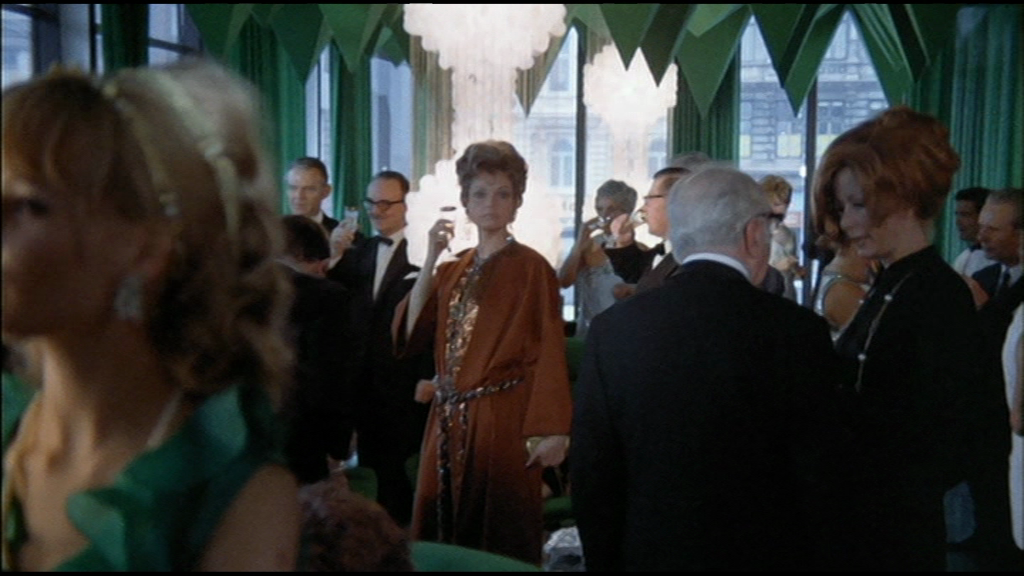
The building’s waiting area also appears briefly in the film: a reception space saturated in vivid green and enclosed by heavy drapery, with large clustered pendant lights suspended low above the seating. Along the ceiling line, angular textile elements descend in irregular points, resembling stylised stalagmites — a motif echoed elsewhere in the building. Warren Platner chairs sit within this field of colour, grounding the room in late-1960s international modernism. Though fleeting, the shot preserves a glimpse of one of the building’s most theatrically conceived reception spaces, designed to immerse visitors immediately in Panton’s total environment as they waited for meetings to begin.
A party set against the backdrop of a swimming pool does take place at the film’s end, though it is clearly not the original famous Spiegel pool. Whether this reflects practical filming constraints or a change of location is unclear, but it is unfortunate that Panton’s basement pool — one of the building’s most ambitious and least documented interiors — does not appear on screen.
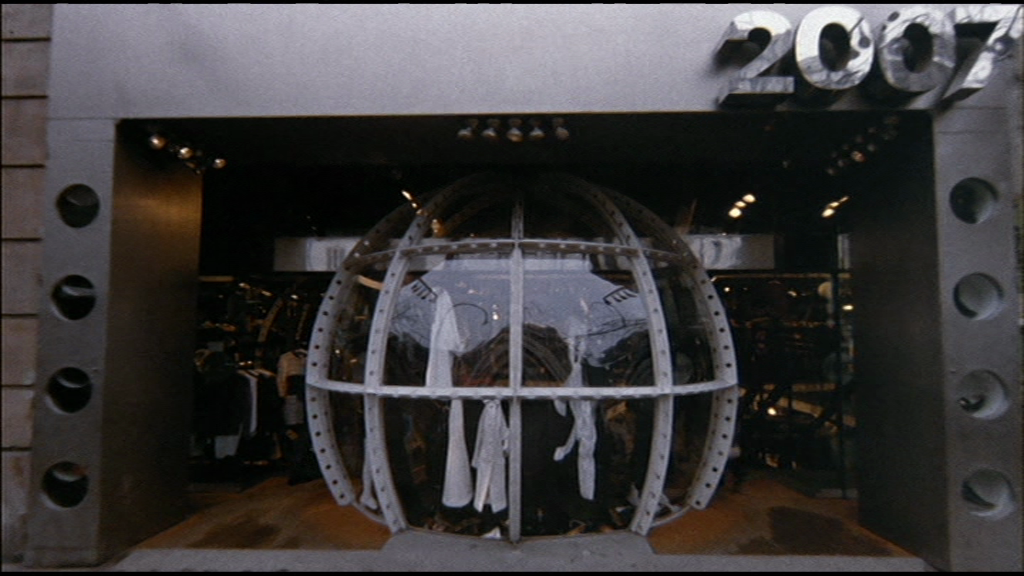
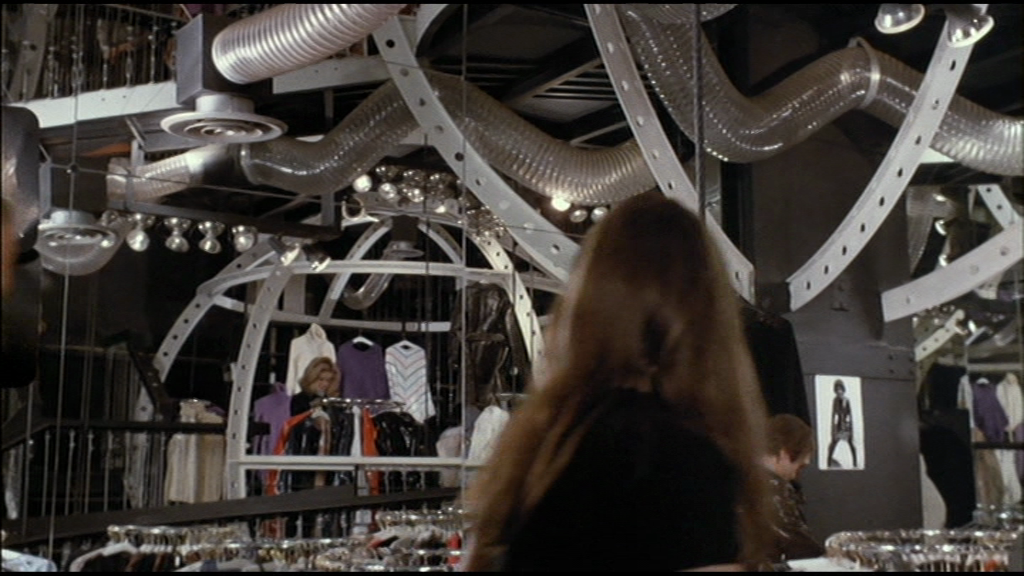
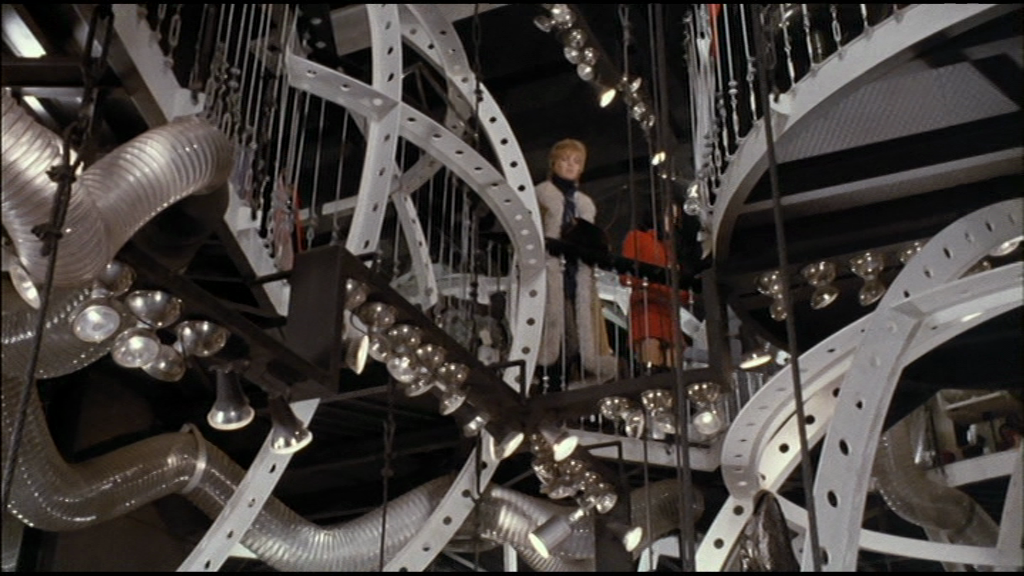
Alongside the impressive design of the Spiegel interiors, the film displays other examples of late 1960s design culture. The film’s main characters, Eva and Terbanks, visit a clothing shop that defies belief — an example of one of those strange futuristic concept stores that emerged in the period. The entrance to the clothes shop is organised around a spherical steel-and-glass pod set within a riveted frame. Inside, garments are arranged against a framework of perforated white arches, mirrored panels and exposed ductwork. Handbags dangle from metal struts, chrome spotlights cluster overhead, and ventilation tubes snake through the space like prosthetic organs. The interior bizarrely appears as part spacecraft, part laboratory rather than a clothes shop — retail rendered as total environment.
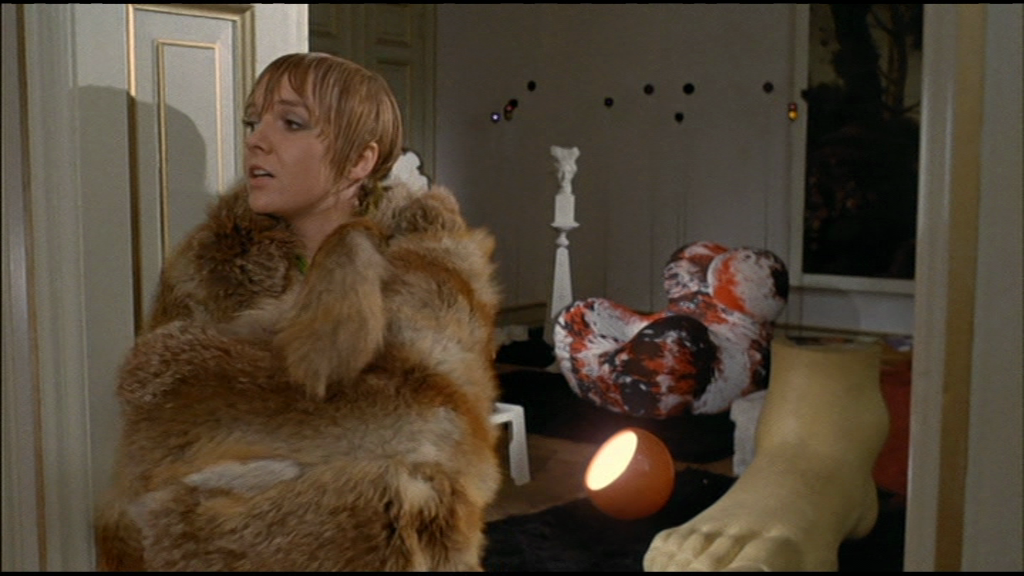
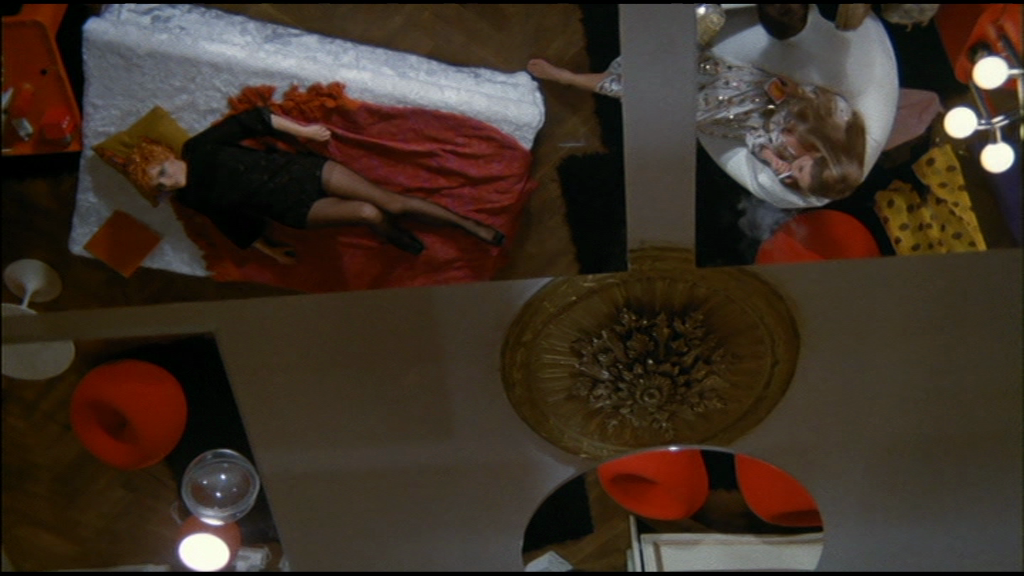
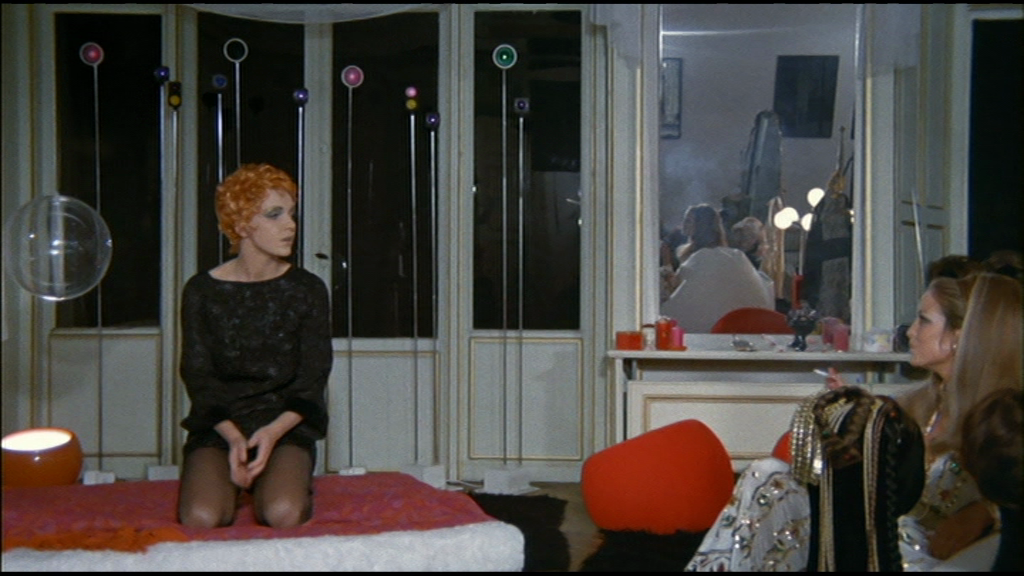
Ohrfeigen also incorporates other hallmarks of late-1960s design into its mise-en-scène, including Gaetano Pesce’s UP5 “La Mamma” chair and the UP7 “Il Piede” foot from his 1969 UP series. These iconic pieces of twentieth century Italian design sit among low modular seating, red spherical floor cushions and chrome globe lamps, reinforcing the film’s sustained engagement with radical design culture of its era.
These design references help to articulate the film’s central conflict. The film, like many comedies of the period, is unmistakably a product of the post-’68 preoccupation with generational and ideological conflict. As such, its comedy largely emerges from the collision between bourgeois affluence and radical youth politics. This tension is largely staged through its comedic dialogue but is also present visually within the film’s sceneographies. The corporate interiors of the Spiegel building inhabited by the bourgeois class are affluent and design conscious; the radicals’ commune, by contrast, is ramshackle and ideologically loaded. Its walls are lined with oversized portraits of Lenin, Ho Chi Minh and Mao. Political sloganeering is displayed beside filing cabinets and record players. The mise-en-scène within these scenes treats ideology as décor - a shorthand for ideological positioning.
Although the film is concerned with ideological satire, it also inadvertently records the corporate modernism of the Spiegel building. In capturing fragments of the Spiegel interiors — the entrance space, the canteen walls, the waiting area — Ohrfeigen preserves aspects of a total environment that no longer fully survives. In this sense, cinema becomes an unexpected archive of Panton’s work, documenting spaces since altered or lost.
For Panton’s interiors, so frequently described as cinematic, this may be one of the few instances in which the term proves literal.
Further information on Verner Panton’s work can be found via the official archive