The Rest Was Like Writing a Book: Fiction, Guilt, and the Limits of Authorial Innocence in Tenebrae
Tenebrae begins with a confession. Over a crackling fire, a pair of leather-gloved hands hold open a copy of Peter Neal's titular novel as a voiceover reads: the impulse had become irresistible, the first murder brought not guilt or anxiety or fear but freedom, and every humiliation that stood in the way could be swept aside by a simple act of annihilation. The book is then thrown into the fire, but the burning is too late, the words have already been read, already transmitted to whoever is sitting at that fireplace.
One might read this as scene-setting, as genre atmosphere, as the kind of epigraph that announces a horror film's intentions, but the words belong to Peter Neal not merely as their author but as their subject. They are autobiographical. The film that follows is the gradual, relentless process of the audience discovering what Neal has known since he was a teenager in Rhode Island: that he wrote those words because he had already lived them.
Tenebrae (1982) is the film in which Dario Argento most fully interrogates his own practice, and in doing so stages an argument with himself that he cannot win. It is a film about a crime writer whose fiction and whose life have been running in parallel for so long that the boundary between them has dissolved. It presents, in the character of Peter Neal, a reasonable man unjustly accused, a creator who argues, eloquently, that he bears no responsibility for how his work is consumed. And then it demolishes that defence entirely, revealing Neal as guilty of everything his critics suspected and more. Tenebrae is a film that makes the case for authorial innocence and then convicts its own defendant.
When Peter Neal arrives in Rome to promote his novel he finds, within hours, that it has preceded him in the worst way imaginable. Detective Germani, an avid reader of Neal's work, is waiting at his hotel to inform him that a girl has been murdered with the pages of Tenebrae stuffed into her mouth. The killer calls that same night, quoting the novel back at Neal, and what becomes clear is that Tenebrae has been taken as something far darker than the pulp fiction it appears to be.
The accusation implicit in Neal's predicament is one Argento was familiar with in his own career. His films had attracted sustained criticism, that they glorified violence, that they were responsible for their audience's worst impulses, that the creator of horror bore some accountability for horror enacted in reality. In 1982 Tenebrae was placed on the UK's video nasties list, deemed obscene and harmful to the general public under the Obscene Publications Act, the state deciding that a piece of fiction was directly responsible for potential real world harm, and in doing so subjecting the film to exactly the logic it interrogates. The accusation was functionally identical to the accusation levelled at Neal by Berti, that the work corrupts, that the creator bears responsibility for what the consumer does with the fiction, that the boundary between imagining violence and enacting it is dangerously permeable. The question of whether a work of fiction could be held accountable for the behaviour it supposedly inspired was not theoretical for Argento. It was professional and personal.
Neal articulates the defence with characteristic urbane precision in the film's key exchange with Detective Germani: "If a man is killed with a Smith and Wesson revolver, do you go to interview the president of Smith and Wesson?" The analogy is deliberately reductive, and Neal knows exactly what he is doing, but it contains a genuine argument. The novelist who writes about murder is not the murderer, and Neal presents himself as a man wrongly implicated by an association that proves nothing about his character or his intentions.
The television critic Cristiano Berti, who has been acting on precisely this kind of misreading, functions in the film as the embodiment of Argento's critics. In the interview scene, Berti describes Tenebrae the novel as being about "human perversion and its effects on society" and Neal pushes back, insisting the book goes beyond such reductive framing. Berti is coded carefully as everything the audience is primed to distrust, the conservative Catholic moralist, the cultural gatekeeper who sees corruption and deviance wherever he looks. Neal by contrast is rational, cosmopolitan, the voice of liberal tolerance, arguing that the killer's categorisation of his victims as deviants says everything about the killer and nothing about the victims. Two men argue about what a novel means, what it permits, what it authorises. One of them is a killer. Germani, quoting Conan Doyle, tells Neal that when you have eliminated the impossible, whatever remains must be the truth. At this point in the film, the audience has not yet eliminated the right impossibility.
Earlier, journalist Tilde challenges Neal on the sexism in his work. When Neal protests that she knows him personally and should know better, Tilde cuts him off: she is talking about the work, not the man. It is a distinction that feels, in the moment, like an injustice, as Neal is being held accountable for a text as though the text were transparent evidence of his character. The film appears to be arguing, reasonably and even sympathetically, that this is unfair. And yet Tilde's accusation isn’t easily dismissed. Argento's films are full of women who are watched, hunted and murdered in elaborate and often beautiful detail, and the question of what that means is one that any serious engagement with his work eventually has to sit with. Tenebrae is unusual in that it stages this argument explicitly, puts it in the mouth of a character the film has coded as an antagonist, and then makes Neal's rebuttal feel entirely reasonable, while simultaneously constructing a film that will eventually prove Tilde's deeper instinct entirely correct: that the work and the man cannot be separated, if not in the way she imagined.
What is striking, at this point in the film, is how completely Argento has engineered our sympathies. Neal is reasonable where Berti is dogmatic, measured where Tilde is accusatory, cooperative where he might be defensive. We have been positioned by Argento to take Neal entirely at his word.
What we learn about Peter Neal arrives in fragments, and the most important fragment arrives last. Germani delivers it in the aftermath: when Neal was a teenager in Rhode Island, a girl he knew was killed. Brutally. He was accused but never tried; no solid evidence, the case never brought to court. The Interpol telex confirms what the film has been hiding in plain sight since its opening frames.
The Rhode Island killing is the foundation on which everything else is built, and understanding it correctly changes the entire architecture of the film. The Smith and Wesson exchange, which felt like a reasonable man making a legitimate argument, becomes a man who knows exactly how guilty he is deploying a rhetorical shield. The cooperation with Germani, which read as civic responsibility, becomes a performance of innocence by someone who has done this before and knows how innocence looks. Even Neal's apparent concussion after Berti's murder, the rock to the head that left him unconscious in the garden, read at the time as the genuine misfortune of an innocent bystander but was itself constructed, the alibi of a man who had just committed the killing Gianni witnessed. This is not a story about a respectable man driven to murder by betrayal, a crime of passion, an aberration. The betrayal, the affair between his ex-fiancée Jane and Bulmer, is the trigger, not the origin of the impulse. Neal is not a man who discovers something monstrous in himself under pressure. He is a man who discovered something monstrous in himself as a teenager, found that it worked, and understood, from that moment, exactly what he was capable of.
The word "freedom" in the opening voiceover is the film's clearest statement about Neal's psychology. In the act of murder he does not experience relief, or release, but freedom. The murder in Rhode Island didn't destroy Neal but solved something, demonstrating to him that the specific problem he was most vulnerable to, humiliation, the collapse of the performed self, had a solution, and he has carried that knowledge ever since. Peter Neal, successful crime novelist, is the self Neal has built to contain what he discovered in Rhode Island.
After Neal is struck on the head at Berti's house, dazed, he tells Anne what he saw in the moment of impact: his mother putting him on the school bus in Rhode Island. The concussion surfaces it briefly, the Catholic upbringing, the strict formation, the regimented world of his adolescence, and then closes over again as Neal collects himself and returns to the present. That world produced someone for whom the discovery of freedom through transgression was intoxicating precisely because everything before it had been so controlled and constrained. The humiliation on the beach was the crack in the formation through which something escaped. That Neal is heard groaning and taking medication before the flashbacks surface is the film's acknowledgement of how much effort that containment requires.
Peter Neal, successful crime novelist, is the construction that made Neal famous and the fiction that will eventually destroy him. He has spent his career writing about the psychology of killers, their formation, their logic, their freedom. He has been processing and fictionalising his own act for years. What Tenebrae the novel contains, Neal has been careful to frame as fiction.
In his discussion of Tenebrae, Argento observed that almost all of a director's films carry a precise style, a way of seeing life, and that this repetition is the mark of authorship. He also described conceiving murder sequences as a form of play, of game, and finding that the sensuality and eroticism emerge in the filming, through the actors and the atmosphere, in excess of anything written in the screenplay. There is something inherently unsettling about a filmmaker who has spent decades imagining elaborate murders in minute detail making a film whose central argument is that imagining violence and committing it are not opposite sides of a divide but points on the same continuum. In describing his own practice, Argento is also, without quite saying so, describing Neal's.
The name of Neal's novel is, of course, Tenebrae, identical to Argento's film. The shared title collapses the distance between the fictional creator and the real one, between the questions the film raises about Neal and the questions it raises about Argento himself. Both men share a title and an obsession, and the same impossible question: where does the work end and the man begin.
Cristiano Berti enters the film as the embodiment of everything Neal has constructed himself against, killing people he considers sexually deviant under a flag of moral revulsion, his operating logic punitive and moralistic in a twisted way. He has constructed a taxonomy of the unacceptable and is eliminating its members, his Catholic formation the source not of doubt or transgression but of absolute and murderous certainty. He is, in the cruder and less controlled sense, acting out an impulse that Neal has been carrying for years.
Argento makes a precise observation about the relationship between the two men: they are not as different as they appear, and are in some respects almost identical. Neal enters the psychopath's role with no friction because he has already mapped the territory from the inside. When Neal identifies Berti as the likely killer, connecting a phrase from Berti's television interview to the language of the killer's letters, the identification is immediate and complete in a way that only makes sense if Neal understands, from the inside, exactly what kind of mind the novel would speak to most directly. He is recognising in Berti a version of himself he has spent years containing.
Neal is not, the film implies, uniquely monstrous but one of a latent population of people who have already killed, already discovered what it produced in them, and returned to ordinary life carrying that discovery invisibly. What brings Neal back to that threshold is the specific combination of humiliation and opportunity, the discovery of Jane's affair with Bulmer providing the motive and Berti's existing murders providing the cover. He kills again because the circumstances make it, in his own logic, possible. That Neal sends Jane a pair of red high heels before he murders her, the fetish object of his original humiliation returned and repurposed as a calling card, makes the connection between Rhode Island and Rome explicit: the same humiliation, the same logic, the same resolution.
Then Germani delivers the theorem. Neal had realised Berti was the killer and then realised that Berti's existing murders could be used. He let the razor killer live long enough to be blamed for the two murders Neal actually wanted to commit, Jane and Bulmer, the two people whose betrayal had activated the Rhode Island pattern. The crime spree was, from Neal's perspective, a plot device. He inserted himself, redirected its momentum, and used it to cover the story he needed to tell. Neal has not just committed two murders, he has authored a narrative designed to contain them.
"The rest," Germani says, "was like writing a book."
In the film’s denouement Germani tells Anne that in Tenebrae the novel Neal had effectively made a confession, laying bare how the act of killing someone who had humiliated him had given him a sense of absolute freedom. The novel the film opened with, the words read over the crackling fire by anonymous gloved hands, was testimony, though it takes the full weight of the film's ending for either Germani or the audience to recognise it as such.
This is the film's thesis statement and its sharpest irony. Not merely that Neal is a skilled manipulator, but that the skills of manipulation and the skills of fiction are identical. When Neal is finally cornered he does not confess in the conventional sense but screams "it was like a book, a book!", reaching for the same metaphor Germani had just used to describe his crimes. The detective and the killer arrive at identical language independently. He plotted the murders the way he plots his novels, structuring information, controlling reveals, managing the reader's assumptions, building toward an ending. The crime is a text, and Neal has been its author since Rhode Island.
Argento made Tenebrae partly in response to being stalked by an obsessed fan, someone who had consumed his fiction and acted on it in ways he neither intended nor endorsed. The Smith and Wesson defence is one he both believed and deployed with considerable wryness. The idea that the creator of horror cannot be held accountable for the horror enacted by a disturbed consumer of his work is one he articulated publicly, and the figure of Peter Neal was, at least in part, designed to make that case on screen.
But Neal is guilty. The defence the film constructs is real and the conviction that overturns it is also real, and Argento holds both simultaneously without resolving the tension between them. The film does not say that Argento is a killer. It says something more precise and more disturbing: that the capacity to imagine violence in sufficient depth and detail, to understand it from the inside, to map its logic with professional fluency, is not neutral, not safely contained in fiction, not something that remains on the page.
Neal does not, in the end, remain the composed and rational figure he has appeared to be. By the final act the urbane novelist who argued so eloquently for the separation of the man and the work is gone, replaced by someone screaming, faking his own death, killing in desperation. The performed self, maintained for decades, dissolves in minutes.
Neal's novel is his confession. The opening voiceover announces this and it goes unrecognised, as it did for Germani until the Interpol telex arrived. Argento's films are, in some sense, his confession too, a precise style, a way of seeing life, a set of obsessions about violence and freedom and the annihilation of humiliation that repeats across decades of work. Whether that constitutes culpability or merely honesty is the question Tenebrae poses and declines to answer.
What it does answer, with the cold clarity of its final act, is that the distinction between imagining and committing, between the novelist and the killer, between the filmmaker and the acts his films depict, is not as stable as either would like to believe. The impulse had become irresistible. Not guilt, not anxiety, not fear, but freedom. Every humiliation swept aside by annihilation. We read these words as genre atmosphere, as pulp darkness, as fiction. They are the most honest thing in the film, placed in plain sight at the start, visible to anyone willing to read them correctly. They are the confession that Peter Neal has been making in every book he has written, that he makes again in Rome, and that is finally heard by Germani, by us, only when it is too late to be anything other than evidence. Dario Argento, who has spent his career announcing his obsessions and watching audiences receive them as entertainment, probably finds this entirely appropriate.
Sources: Dario Argento in conversation with Antonio Tentori, from Sensualità dell'Omicidio (c.1997); full transcript of Tenebrae (1982, dir. Dario Argento).
A companion piece to this article, Peter Neal: A Bibliography, exploring Neal's other novels as visible in the production design of Tenebrae, is also available on Hypnotic Crescendos. Both pieces form part of a proposed issue of Retinal Burn, a forthcoming film zine from Hypnotic Crescendos dedicated to Tenebrae specifically, available as a digital publication. If you'd like to see that issue realised, please consider showing your support via the Retinal Burn page, leaving a comment, or getting in touch directly. A sincere thank you to Spencer Smallwood for his kind support of this site, which makes pieces like this possible.
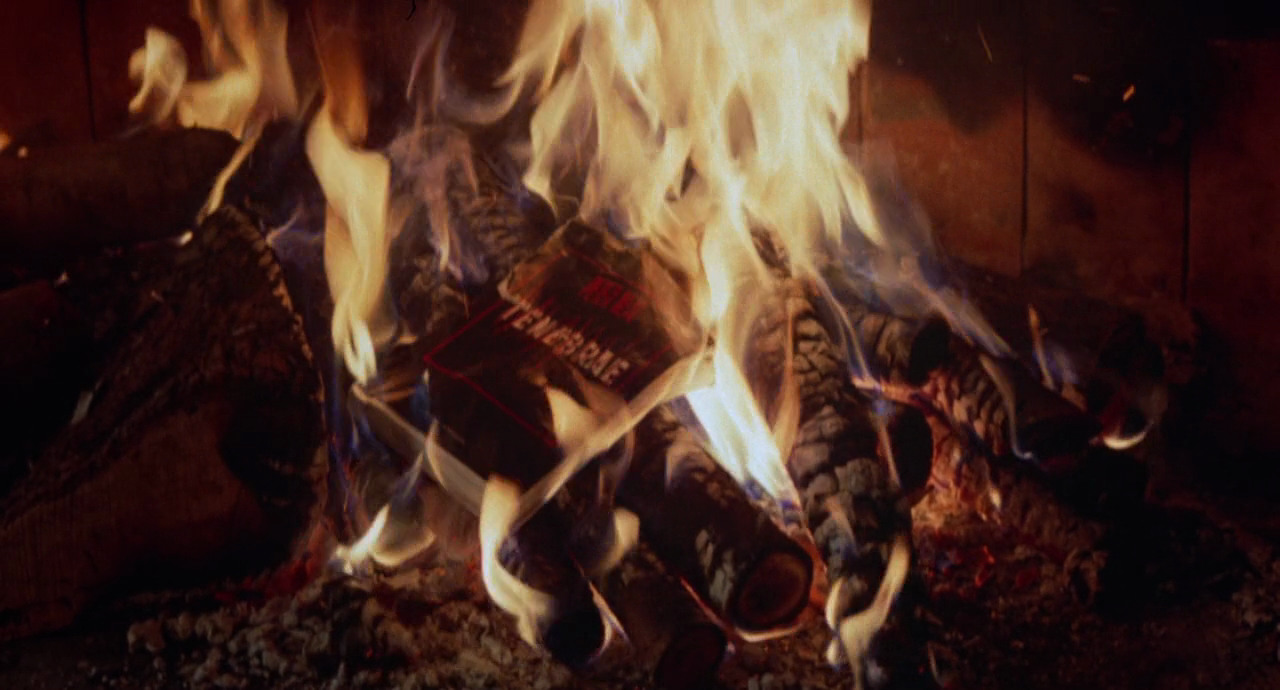
Tenebrae (Dario Argento, 1982)
